In this follow up to Part 1 of the article “How You Can Change the Future” I would like to provide a simple example to illustrate how applying the Socratic Method to reviewing an issue can help break it down to its essential components, isolate the potential problem areas and then help uncover the best options for dealing with it.
One of the examples described in part 1 of this article was of living near an industrial plant or on the site of an old industrial plant that may have been polluted but has been “cleaned up” and sold to home owners. Here are some questions one might ask;
- Do you accept that the site or nearby industrial plant is safe because the plant owner / property developer, State or local government declare it to be safe?
- If the community accepts these assurances should you question it?
- Do you take it upon yourself to check this fact regularly?
- How do you go about checking it?
more…
Every society has its “norms” by which I mean the conventions we follow, the beliefs we hold. Many are untouchable, often without question, because by following them life is easier all round, for everybody else and for us.
We entrust our kids to priests, scout masters, family, teachers and so on for their training and enrichment; we deposit our money in banks so they will look after it and us when we need a loan, we live near industrial plants trusting they will not pollute the air we breathe, the rivers we use or the ground we play on. In short we trust the accepted conventions, some call it the “Rule of Common Sense”.
more…
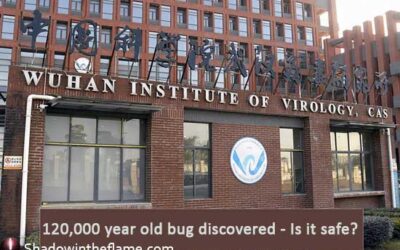
A bug that has lain dormant for over 120,000 years has been revived by Dr Jennifer Loveland-Curtze and a team of scientists from the Department of Biochemistry and Molecular Biology at Pennsylvania State University.
The Story in Brief
Scientists who want to go bug hunting in space practice by searching out dormant bacteria on earth and reviving them for research.
The latest bug, a tiny brown-purple microbe was discovered when a Gram-negative 1 ultramicrobacterium was isolated from a 120,000-year-old Greenland glacier ice core recovered from a depth of 3,042 metres (3.042 kilometres).
Dubbed Herminiimonas glaciei, the pigmentation of the original colony was brown-purple but after recultivation the colonies were translucent white to tan coloured. It took almost 12 months for the team to revive the microbe (designated strain UMB49T) by gently warming it in an incubator at 2%C for seven months and then at 5%C for a further four and a half months .
The H. glaciei microbe is tiny – ten to 50 times smaller than E. coli (which is also Gram-negative 1). Experts say its small size probably helped it to survive in the liquid veins among the ice crystals.
Dr Loveland-Curtze says that other microorganisms could exist on other worlds and studying Microbes found in extreme conditions on Earth may provide insight into what sorts of life forms could survive elsewhere in the solar system.
More details are available at the International Journal of Systematic and Evolutionary Microbiology and it was reported in the Scientific American in June 2009.
more…
Thank you for this article, It was a great read which was extremely helpful.
I genuinely liked that post. I is going to be reading a lot far more of this blog. But I am a little confused, and have a tiny question. if you is balanced, unbiased and cold how can you love someone? Is that why you call it Doctrin of the mean?
What you describe as hardened science people are usually materialist that dogmatically (faith based) defend materialism (nothing exist except matter in motion) that excludes the possibility of anything paranormal, despite repeated demonstrations of it’s existence by the all the standards of science.
I thought it was going to be some boring old post, but I’m glad I visited. I will post a link to this page on my blog. I am sure my visitors will find that very useful.
I saw your blog bookmarked on Digg. I love your website and articles. Keep up the fine work.
Another new inclusion, I truly couldn’t have explained that much better myself.
Very thoughtful piece of info. I never thought it was this straight forward afterall.
Nice one. Thanks for such an insightful article. I have been attempting to explain the same thing to my homies but I think it’s easier if I simply send them the link to this page instead!